Edtech apps have taken over classrooms at an alarming pace, but do we really understand how the motivating factors and learning components within apps are actually working? As a teacher, parent or homeschooler, how do you choose which app is best for your child or student? Many of us tend to go with the one that looks the best or seems the most engaging, but is that really the best for learning and development?
Yes, play is important for learning, but many of the apps don’t really utilize true play, in the context of learning and development. It also seems like they are mistaking fun, motivating gamification mechanics for helpful learning mechanics. The truth is, some apps can do more harm than good. In this article, I want to break down and properly define the different types of fun and play and how they factor into learning and development...
Fun vs Play
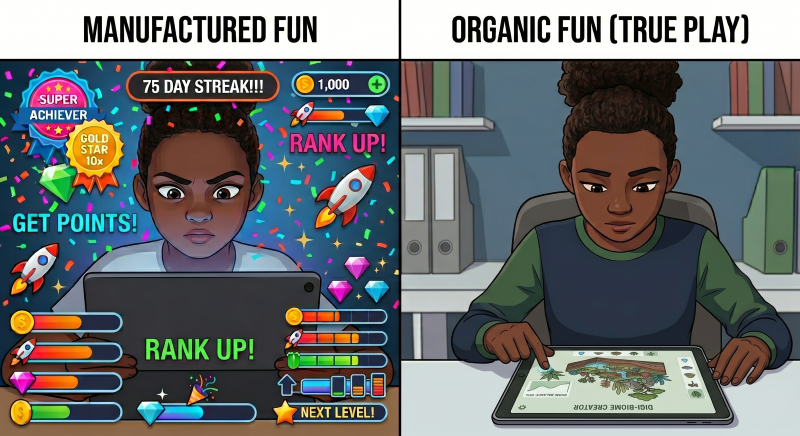
Let’s differentiate between two different types of fun: manufactured fun and organic fun. Manufactured fun is the extrinsic motivator that many apps use and includes gamification mechanics, like badges, points and streaks. These use the promise of a fun state of mind as motivation.
Then you have organic fun, which is the actual state of mind that provides amusement, pleasure or enjoyment. The difference is that with organic fun, the activity is fun within itself, not just the rewards that you get from doing the activity.
This leads us quite nicely into the concept of play, which according to the National Institute for Play is:
- self-chosen and self-directed;
- intrinsically motivated;
- structured by internal rules;
- imaginative and creative;
- and involves a state of mind that is engaging, focused and free of judgement or external consequences.
Many aspects of organic fun are part of play, but notice that the two are not the same.
The problem with fun
As we already mentioned, manufactured fun is what usually happens when we think of gamification within education. There is nothing wrong with it, in and of itself. We all like a badge or to see our points go up, but it is how it is used that can often lead to problems. Two issues spring to mind:
- The points and badges are an indication of progress; they are not the progress itself. Sometimes the points you get bear no resemblance to the actual real progress made at all, and this happens when the developers are not educators, and have not done the required research.
- Points are often an add-on to sweeten the boredom of the actual work we are trying to get the students to do. There is never a direct link to try and get the students to enjoy the learning.
In both cases, this type of gamification can overshadow the learning experience, which should always be the focus in the context of education. Think of apps like Duolingo which focus on badges, competition and streaks, the fun parts of the app. Many users (myself included!) strive for high marks and the longest streaks, achieve those but can not actually speak the language they are learning. The sense of achievement is skewed. They are doing great at Duolingo, but not at the thing they are using Duolingo for. The fun part gets in the way of the actual learning which may be fun to some, but is no longer the main focus. This can then lead to gaming the system, and cheating in some cases, to try and get the points, the badges and maintain the streak without actually learning as much as is needed, defeating the whole purpose.
True Play and the Harvard experiment
True play, like organic fun, is intrinsic in nature. The students get enjoyment not from the rewards for doing the thing, but from actually doing the thing. Seymour Papert, MIT professor in the 1970s and creator of the Logo programming language, coined the phrase ‘Hard Fun’. The activity is fun because it is hard, not in spite of it being hard. The Beach Bowling experiment by the Harvard Graduate School of Education explains this really well.
In this study, researchers watched primary aged children play a bowling game where the children had full control over all the rules and variables. They could change the weight of the projectiles, the distance to the pins and anything else they wanted, to make the game as easy or as hard as they pleased. There were two modes for the experiment. Play to win: where they would get an extrinsic reward for meeting whatever rules they set; or play for fun: where there was no reward, no winning or losing, just play.
When the objective was to "win," children were observed choosing the easiest settings to make sure they got the most reward. But, when playing for fun they intentionally made it as difficult as they could for themselves. They used the heaviest projectiles with the furthest distance to the pins.
The study showed that both avenues, playing for points and playing for fun, were equally enjoyable to the students. But in the context of education and learning, playing for fun, organic fun, was more beneficial. When winning was not the objective, and without the external pressures of scores, badges or points, students enjoyed the struggle much more. And this is where true learning lives. The struggle to advance, intrinsically motivated, led them to naturally seek out the best way to achieve their own goals, improve and advance. They embraced the risk when there was no pressure of failure, and they found fun and enjoyment in this. So, both were fun, but only one led to real learning and development.
Only one was true play
Playing to win was not true play because according to the National Institute for Play definition it only met 3 of the 5 criteria. It was self-chosen and self-directed, structured by internal rules, and was imaginative and creative. However it was not intrinsically motivated as the focus was the score, and it was not free of judgement or external consequences. The playing for fun mode of the experiment was organic fun and was the only one that met all 5 criteria, and therefore was true play.
Choosing the right apps
We have now looked over two different types of fun, organic and manufactured. We also know what true play is, in the context of learning and development. Now to use that knowledge to find or test the best apps, try doing the following 3 things:
Test drive it yourself
Evaluate the app yourself to make sure it uses a minimalist, research-backed design. Keeping gamification simple helps avoid unnecessary distractions and keeps the focus on learning.
Look for hard fun
Ensure the app challenges the student to think critically and figure things out themselves. The app should champion "hard fun" rather than making tasks artificially easy just to hand out rewards.
Verify meaningful progress
Watch your student use the app to make sure they are genuinely engaged in mastering the material. Look past high screen time (which can be a false sense of success) to verify they are getting real-world knowledge rather than mindlessly chasing streaks or getting points.
Finding an app that offers true, rule-free play is still really rare in today's edtech landscape. We aren't really there yet. However, by looking for these three things, you can confidently choose tools that get learning and motivation right. What apps are your students using right now? Do they pass the smell test?
Sources
- What is Play? Definitions & Characteristics | NIFPlay - National Institute for Play
- Hard Fun - The Daily Papert
- Why Do Children Play? | Harvard Graduate School of Education
- Cognitive Engagement and Motivation in Education: A Psychological Perspective
- Edutainment? No Thanks. I Prefer Playful Learning
- Learning through play: a review of the evidence
- Play vs. Learning: A False Dichotomy in Early Childhood Education - Collaborative Classroom
- Why Fun, Curiosity & Engagement Improves Learning: Mood, Senses, Neurons, Arousal, Cognition
- Image by Gemini